pyvista-frd-reader#
Read and write CalculiX .frd result files as
pyvista.UnstructuredGrid objects. The parser is also available through
a C API.
Install the package, read a file, and select result steps.
Read, plot, convert, and inspect solver output.
Python classes, functions, errors, and the C API.
import pyvista_frd

mesh = pyvista_frd.read("result.frd")
mesh.plot(scalars="STRESS_Mises")
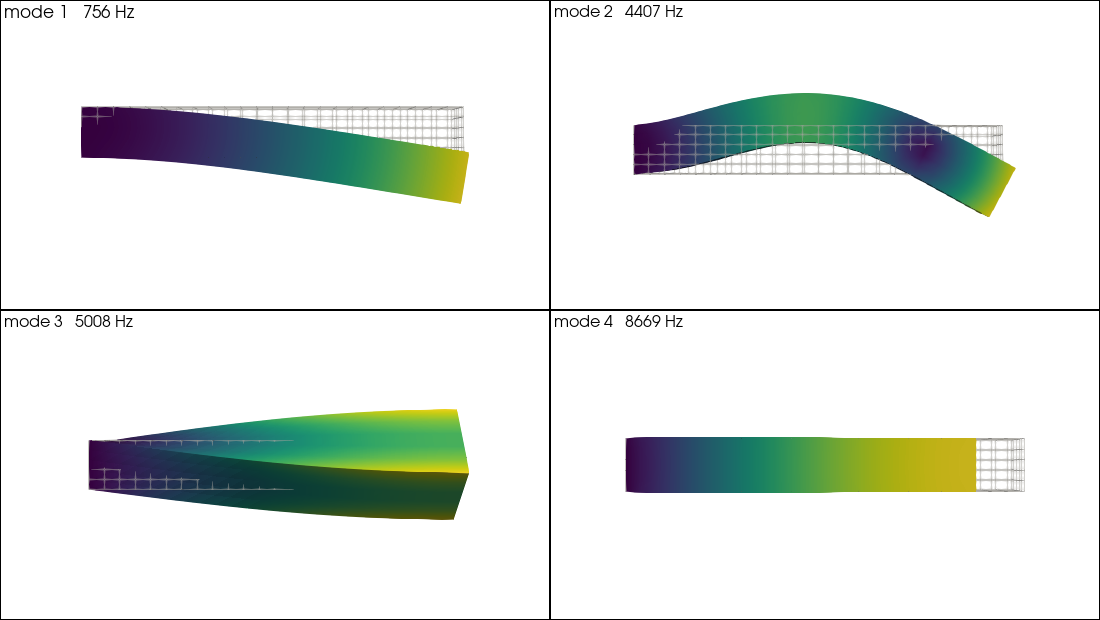
The first four modes of a cantilever, read from the four steps CalculiX wrote for them. Step through a multi-step file#
Capabilities#
CalculiX writes analysis results to FRD files. This package reads all four FRD encodings, writes long ASCII and binary FRD, and converts record encodings.
Read short ASCII, long ASCII, binary float32, and binary float64
records. Preserve or convert their encodings.
Import set masks and plot named faces with their current-step results.
Write PyVista meshes to FRD or convert an existing file without building a mesh.
The conformance suite compares mesh and result arrays with PyVista’s built-in reader.
Use the parser from C, C++, WebAssembly, or another language with a foreign-function interface.