Note
Go to the end to download the full example code.
Derived stress quantities#
CalculiX stores a six-component stress tensor. This reader derives von Mises stress and principal values under the names used by PyVista’s FRD reader.
For any array whose name contains STRESS or STRAIN and which has six
components, five arrays are appended.
List the stored tensor and derived arrays.
print('stored :', mesh.point_data['STRESS'].shape, '(xx, yy, zz, xy, yz, zx)')
for name in ('STRESS_Mises', 'STRESS_sgMises', 'STRESS_PS1', 'STRESS_PS2', 'STRESS_PS3'):
    print(f'derived: {name:16s} {mesh.point_data[name].shape}')
stored : (900, 6) (xx, yy, zz, xy, yz, zx)
derived: STRESS_Mises     (900,)
derived: STRESS_sgMises   (900,)
derived: STRESS_PS1       (900,)
derived: STRESS_PS2       (900,)
derived: STRESS_PS3       (900,)
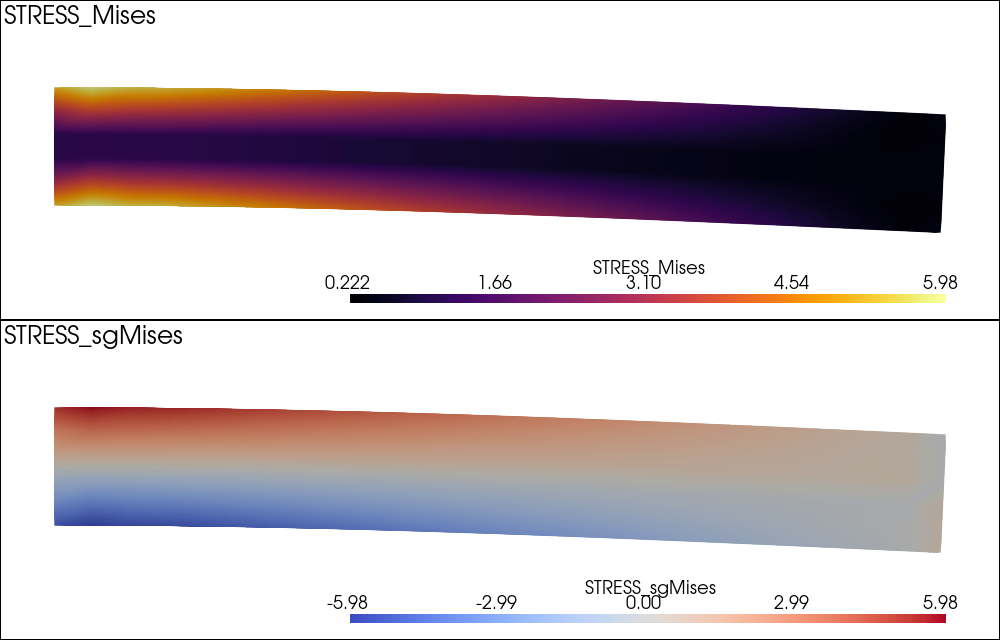
_sgMises applies the sign of the tensor trace to the von Mises magnitude.
The sign separates the tensile and compressive faces of this bent beam.
warped = mesh.warp_by_vector('DISP', factor=200)

pl = pv.Plotter(shape=(2, 1), window_size=(1000, 640))
for row, (name, cmap) in enumerate((('STRESS_Mises', 'inferno'), ('STRESS_sgMises', 'coolwarm'))):
    pl.subplot(row, 0)
    pl.add_text(name, font_size=10)
    pl.add_mesh(warped.copy(), scalars=name, cmap=cmap)
    pl.camera.tight(padding=0.12, adjust_render_window=False, view='xz')
pl.show()
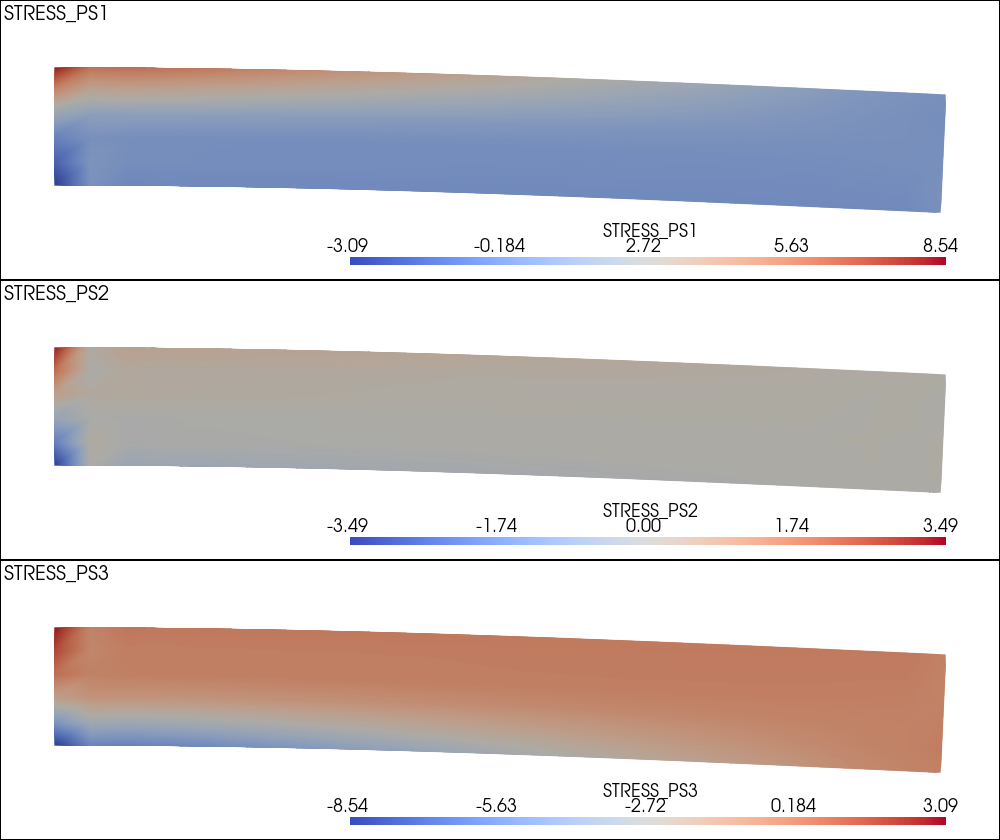
The principal values are ordered from largest (PS1) to smallest
(PS3).
pl = pv.Plotter(shape=(3, 1), window_size=(1000, 840))
for row, name in enumerate(('STRESS_PS1', 'STRESS_PS2', 'STRESS_PS3')):
    pl.subplot(row, 0)
    pl.add_text(name, font_size=9)
    pl.add_mesh(warped.copy(), scalars=name, cmap='coolwarm')
    pl.camera.tight(padding=0.12, adjust_render_window=False, view='xz')
pl.show()
CalculiX does not store these derived arrays. The conformance tests require the von Mises arrays to match PyVista bit for bit. Principal values use a tolerance because the two implementations use different eigensolvers.
mises = mesh.point_data['STRESS_Mises']
tensor = mesh.point_data['STRESS']
trace = tensor[:, :3].sum(axis=1)
print(f'peak von Mises      {mises.max():10.3f}')
print(f'nodes in tension    {int(np.count_nonzero(trace > 0)):10d} of {len(trace)}')
peak von Mises           5.980
nodes in tension           450 of 900
Total running time of the script: (0 minutes 0.623 seconds)