Note
Go to the end to download the full example code.
The four encodings#
FRD defines two ASCII and two binary encodings. CalculiX writes binary output
for *REFINE MESH and DOUBLE output cards.
The reader handles all four encodings. The writer creates long ASCII and both binary encodings; the converter also preserves existing short ASCII records.
pyvista_frd.convert() changes record encoding and preserves lines that
the parser does not need to interpret.
source = DATA / 'cantilever.frd'
sizes = {'long ASCII (source)': source.stat().st_size}

for label, kwargs in (
    ('binary float64', {'binary': True}),
    ('long ASCII', {'binary': False}),
):
    target = tmp / f'{label.replace(" ", "_")}.frd'
    pyvista_frd.convert(source, target, **kwargs)
    sizes[label] = target.stat().st_size

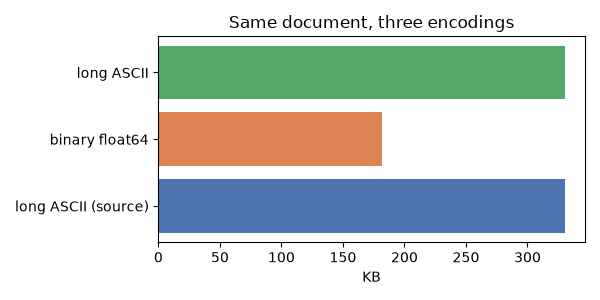
for label, size in sizes.items():
    print(f'{label:22s} {size / 1024:8.0f} KB')
long ASCII (source)         330 KB
binary float64              181 KB
long ASCII                  330 KB
Compare file sizes. Binary keeps the stored doubles; ASCII writes six significant digits.
Confirm that the converted file has the same mesh structure.
original = pyvista_frd.read(source)
converted = pyvista_frd.read(tmp / 'binary_float64.frd')
print(f'points  {original.n_points} -> {converted.n_points}')
print(f'cells   {original.n_cells} -> {converted.n_cells}')
print(f'arrays  {len(original.point_data)} -> {len(converted.point_data)}')
points  900 -> 900
cells   600 -> 600
arrays  15 -> 15
Binary-to-ASCII conversion creates a file that ASCII-only readers can open.
CalculiX formats ASCII after casting to float32; this writer formats its
stored float64 value. The final digit can differ at a rounding tie.
Total running time of the script: (0 minutes 0.104 seconds)